
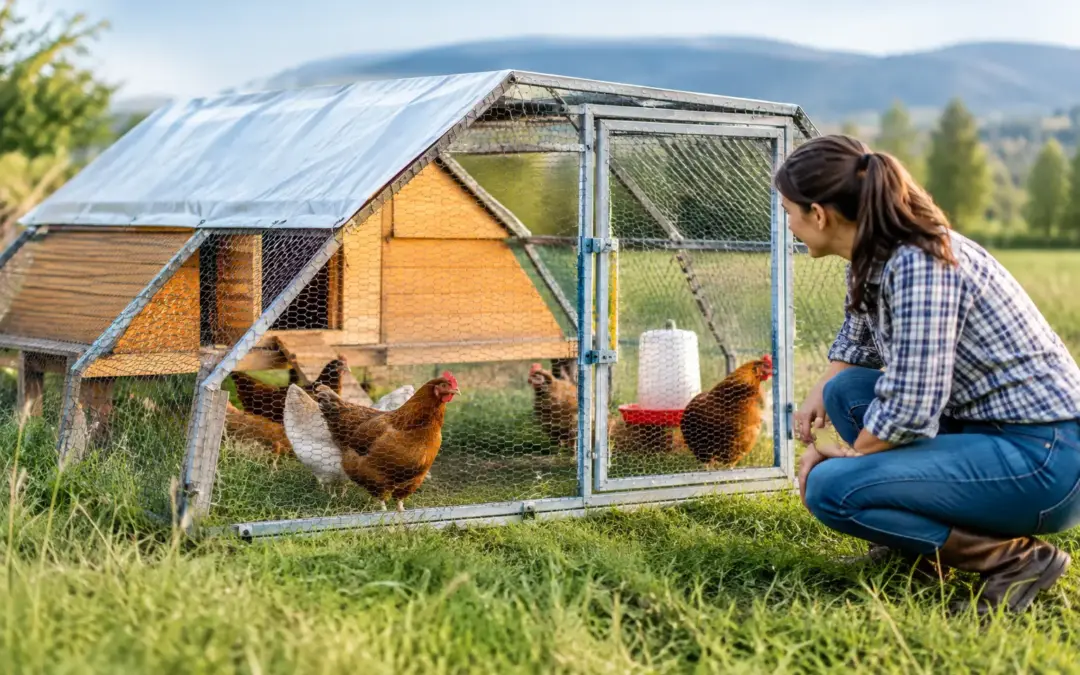
A chicken tractor can look excellent in a product photograph and still be a miserable piece of housing once it meets wet grass, a determined fox and a flock that will not walk through a low pop-hole. That is why useful chicken tractor reviews go beyond stars, dimensions and whether it arrived on time. They tell you what happened after a few weeks of moving it, cleaning it and shutting the birds in at dusk.
For a small flock, the right movable coop can reduce muddy runs, spread manure across the ground and put birds on fresh forage. The wrong one becomes a heavy, draughty compromise that is awkward to tow and too flimsy to trust overnight. Here is how to read reviews with a keeper’s eye rather than a catalogue’s eye.
What a chicken tractor needs to do
A true chicken tractor is mobile housing with an attached run, designed to be moved regularly across pasture or lawn. It is not simply a small coop with wheels added as an afterthought. The birds need secure overnight shelter, enough ventilated but dry space to roost, and daytime access to ground that is genuinely fresh when the unit moves.
That sounds straightforward, but every design is a trade-off. A compact tractor is easier for one person to shift, yet may suit only two or three bantams. A larger unit gives standard hens more room and can carry deeper litter, feed and water, but it needs good wheels, a sensible towing point and reasonably level ground. If a review says a tractor is easy to move, look for the flock size, terrain and whether the reviewer moves it daily or once a week. Those details matter more than the claim itself.
Chicken tractor reviews: the details worth trusting
The most useful reviews describe the conditions of use. A keeper dealing with a sheltered, level garden will have a different experience from someone moving a tractor across a sloping Welsh smallholding after a week of rain. Neither is wrong, but their needs are not identical.
Give extra weight to reviews that answer practical questions. Did the timber twist or split through winter? Did the roof stay watertight at the joins? Can one adult move it without lifting most of the weight? Does the wire stay tight when the tractor is dragged? Are there sharp edges, awkward catches or gaps around doors? Has the unit remained secure after a fox has investigated it?
Be cautious with comments written on the day of delivery. They can be helpful for judging instructions, packaging and assembly, but they tell you very little about durability. A six-month review with photographs of wear points, wheels and roof material is far more valuable. So is feedback from someone keeping the same sort of birds as you. Large fowl, light hybrids, heavy breeds and bantams do not use space in quite the same way.
A poor review also deserves context. A tractor that fails because it was left in a waterlogged hollow may not be inherently poor. Equally, do not dismiss repeated reports of cracked wheels, leaking roofs or fox vulnerability as user error. Patterns are the point of reading reviews.
Start with your flock, not the advertised capacity
Manufacturers’ capacity figures are often optimistic, particularly where daytime run space is included in the calculation. Treat them as a maximum under favourable conditions, not a target. Birds that are confined during bad weather, on short winter days or while you are away need more room to remain settled.
Consider their body size and temperament. A trio of Silkies can live comfortably in a footprint that would be tight for three Orpingtons. Active light breeds may use a tractor well if it is moved often and they have additional ranging time. Heavy birds need a low, easy route to the sleeping area and sturdy perches that do not flex. If the coop is raised, check that the ramp has grip and is not so steep that reluctant birds sleep outside.
Also think about where feed and water will sit. Putting both inside a small tractor can quickly consume usable room and create damp bedding. Leaving them outside may work during the day, but it can attract wild birds and makes the setup less useful if you need to keep a flock contained. Good reviews mention the everyday routine, not just the structure.
Build quality shows at the weak points
A chicken tractor spends its life being pulled, pushed, rattled and exposed. The weak points are rarely the big side panels. They are hinges, catches, wheel brackets, handles, roof fixings and the join between the timber frame and welded mesh.
Timber should be sufficiently substantial for the span it carries, with treated surfaces appropriate for outdoor use. Thin decorative cladding may look tidy but does not make a durable frame. If a design relies on lightweight timber, look for bracing that prevents racking when it is moved. In reviews, phrases such as “needed reinforcing” should prompt a closer look at exactly what was reinforced and why.
Mesh deserves the same scrutiny. Chicken wire keeps chickens in, but it is not a reliable barrier against a fox, dog or determined mink. For overnight security, welded mesh of a suitable gauge, well fixed to the frame, is the stronger choice. Check how the mesh meets the ground too. A movable tractor cannot be buried into the soil like a permanent run, so its security depends on a close fit, a level resting position and regular checks for gaps.
Roofing needs an overhang and a route for rainwater to run away from doors and seams. Clear plastic panels can brighten a shelter, but they can also create overheating in direct sun. In the UK, rain is usually the immediate concern, though ventilation must not be sacrificed to make a coop weatherproof. Dry air without a constant draught at perch height is the balance you want.
Mobility is the feature that earns its keep
A tractor that cannot be moved easily will soon stay in one place, defeating the purpose. This is where reviews can expose a gap between a clever design and a practical one. Wheels need to take weight before the frame begins to scrape, and handles need enough leverage for the person actually doing the job.
Ask how the design behaves over your ground. Small solid wheels may be fine on a short lawn but struggle in rough pasture. Pneumatic wheels roll better over uneven land, although punctures and pressure checks come with the territory. A long tractor can bridge minor bumps but may be hard to turn. A narrow tractor can pass through gates but can feel less stable in wind.
If you work alone, do not buy on the assumption that a second pair of hands will always be available. Watch for reviewer comments about lifting, not just towing. Some units are technically mobile but require one end to be picked up high enough that bedding, drinkers and loose fittings shift about. That makes daily moves a chore.
Welfare, weather and predator pressure
Fresh grass is a benefit, not a substitute for sound husbandry. Chickens will strip a small patch quickly, especially if the tractor is stocked heavily or left in place for several days. Move frequency depends on flock size, grass growth, weather and whether the birds also have access to a larger area. In wet spells, a tractor should be moved before the ground turns into bare mud, not afterwards.
Look for enough covered area for birds to get out of driving rain and strong sun. A fully open run can be useful in fine weather but leaves feed, water and birds exposed. Partial solid cover, paired with airflow, is generally more practical. The sleeping compartment should be simple to inspect and clean. If you cannot reach every corner without crawling through a small door, red mite checks and bedding changes will become neglected jobs.
Predator protection should be judged honestly. A lightweight tractor may be suitable only where birds are supervised during the day and shut into a more secure fixed coop at night. A heavier, well-built tractor with reliable bolts and secure mesh may be a viable overnight home, but location still matters. No portable structure is a licence to stop checking catches, mesh and the ground line.
Questions to ask before buying
Before committing, ask the seller what the tractor weighs when empty, whether one person can move it, and what ground it was designed for. Confirm the internal sleeping dimensions rather than relying on the total footprint. Ask what mesh is used, how it is attached, whether the roof is replaceable, and whether spare wheels or panels are available.
For a second-hand tractor, inspect it in person if possible. Pay close attention to the underside, as rot often starts where wet grass meets timber. Open every door, test every catch and look for stretched mesh. A bargain that needs a new roof, new wheels and a rebuilt base is rarely a bargain once your time is counted.
The best chicken tractor is not the biggest, prettiest or most heavily advertised option. It is the one that fits your birds, your land and your daily routine well enough that it gets moved when it should. Buy with that reality in mind, and your flock will benefit from fresh ground without you inheriting another difficult job.