
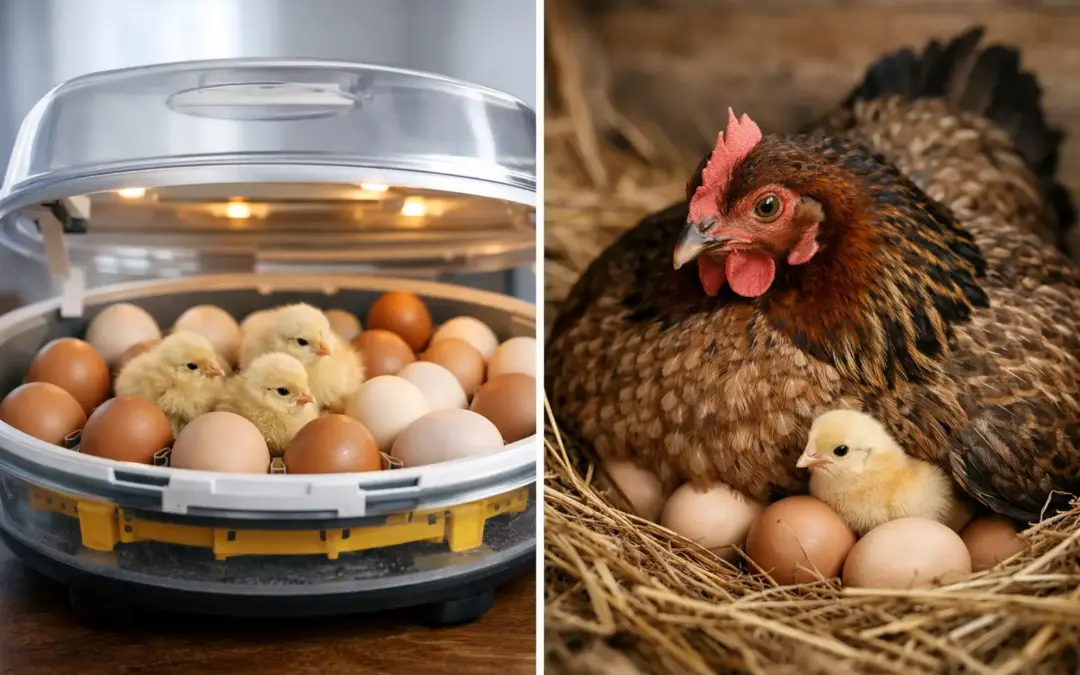
A clutch of good eggs is too valuable to leave to guesswork. The choice of incubator versus broody hen affects more than hatch rate: it shapes your workload, the timing of your breeding season, chick welfare and the way you manage your flock afterwards.
Neither method is automatically better. A steady, proven broody can hatch and rear chicks with very little intervention. A well-run incubator gives a breeder control, capacity and the ability to hatch when no hen is willing. The right answer depends on the eggs, the birds and how hands-on you want the process to be.
Incubator versus broody hen: the real difference
An incubator replaces the hen’s work with controlled heat, humidity, ventilation and egg turning. You set the conditions, candle the eggs, move them into lockdown and manage the chicks once they pip. It is a practical tool for planned breeding, especially where several pens are producing eggs at the same time.
A broody hen does all of that herself, with one major advantage no machine can provide: once the chicks hatch, she keeps them warm, teaches them to eat and protects them as they learn the flock’s routines. For a backyard keeper wanting a modest number of naturally reared chicks, that is hard to beat.
The catch is that broodiness cannot be booked into the diary. Some hens sit early, some late, and some breeds are famously unreliable. An incubator runs to your schedule. A hen runs to hers.
When an incubator is the stronger choice
For breeders working with rare breeds, carefully selected pairings or eggs from several valuable pens, an incubator gives useful control. You can collect eggs over a short, sensible period, store them correctly, then set a full batch together. That makes records, hatch dates and chick management far easier.
Capacity matters too. A broody bantam may cover six to 10 standard eggs comfortably, while a large fowl hen may manage more, depending on her size and the season. An incubator can hold a larger, more predictable number. If you are hatching from more than one breeding group, that flexibility soon becomes essential.
An incubator is also the sensible route when your hens are not broody, when you want to preserve egg production from a particularly useful hen, or when you need chicks at a particular point in the season. Keepers who show, sell breeding stock or maintain separate lines often need that certainty.
That control comes with responsibility. Temperature needs to be stable, humidity needs managing rather than guessed at, and eggs must be turned until lockdown unless the machine does it for you. A power cut, poor calibration or a rushed lockdown can cost a whole hatch. Buy a reliable unit, test it before setting precious eggs and keep a second thermometer handy rather than trusting a display without question.
Incubator work does not end at hatch
The common mistake is to view an incubator as an easier option. It is easier to schedule, not necessarily easier to manage. Newly hatched chicks need a clean, secure brooder with suitable heat, dry litter, water that cannot be fouled or climbed into, and chick crumb available from the start.
You will also need space to grow them on. By the time the chicks feather up, they need a safe transition away from artificial heat and, eventually, a careful introduction to the main flock. If you cannot provide that set-up, a hen may be the more practical parent.
When a broody hen earns her keep
A committed broody is a smallholder’s best incubator and brooder combined. She regulates the eggs, turns them, adjusts her position as the embryos develop and usually gets the timing right without a hygrometer in sight. More importantly, she raises the chicks in a way that requires little artificial intervention.
Chicks reared under a capable hen tend to be active, weather-aware and quick to learn. Mum shows them where to scratch, what to peck at and when to take cover. They can spend time outside far earlier than brooder-raised chicks because they can return to her warmth when needed.
This route is particularly useful for small hatches. If you have six fertile eggs from a pair you want to continue, placing them under a trusted broody is often simpler than firing up an incubator and running a brooder for a handful of chicks.
But choose the hen, not just the idea of a hen. A bird that has previously hatched and reared chicks calmly is worth far more than one that merely sits tightly for a few days. Avoid using a nervous, low-ranking hen where other birds can harass her, and do not assume every broody will accept substitute eggs without fuss.
Give her a proper nursery pen
A broody needs a quiet, dry and secure nest area, ideally separated from the main flock. In a shared coop, other hens may lay in her nest, break eggs, disturb the clutch or peck newly hatched chicks. A separate broody pen also lets you monitor her food, water and condition without creating daily drama around the nest.
Set her on clean bedding and make sure she can leave the nest safely for her short daily break. Mark or remove any fresh eggs laid by other hens. Once chicks hatch, use a low-sided drinker and chick-safe feed, and check that the pen is rat-proof and free from gaps a tiny chick can squeeze through.
A broody does not remove the need for checks. She reduces the work, but she should still be inspected daily. Watch for cracked eggs, signs of mites, a hen losing too much condition, or chicks that have become separated from her.
Hatch rates: management beats method
People often ask which produces the better hatch rate. The honest answer is that good eggs and sound management decide most of it.
A high-quality incubator cannot rescue infertile, old, poorly stored or badly handled eggs. Equally, the best broody cannot compensate for an unsuitable nest, persistent disturbance or eggs that were chilled before she sat. Start with eggs from healthy, well-managed breeding stock, collected regularly and handled with clean, dry hands.
For posted hatching eggs, expectations should be realistic. Transit can affect hatchability even where eggs are packed properly, and no breeder can control every bump and temperature change after dispatch. Let eggs settle point-down in a cool room before setting, then follow the breeder’s advice where it differs from general rules for the breed.
Candling is useful in both systems. With incubated eggs, it helps identify clears and early losses, reducing the risk of spoiled eggs contaminating the set. Under a hen, be discreet and efficient. Lifting a broody repeatedly to satisfy curiosity is a poor trade for a few extra checks.
Cost, space and flock planning
The initial cost of an incubator can be modest or substantial depending on capacity and features, but the real cost includes electricity, a brooder, heat source, bedding and somewhere to rear the chicks. A broody appears cheaper, yet she may stop laying for weeks and takes up valuable pen space while sitting and raising her brood.
Timing also matters in the British climate. Early chicks can be raised successfully, but artificial brooders need dependable warmth and protection from cold sheds and draughts. A broody offers natural heat, though she still needs dry shelter. Later hatches may be easier on temperature, but leave less time for pullets to mature before winter and for young cockerels to be assessed or rehomed.
Before setting any eggs, decide what happens to every chick. Sex ratios are not kind to optimistic planning, particularly with straight-run heritage breeds. Keep enough space for growing birds, a clear plan for surplus males and the patience to assess young stock properly before calling it breeding quality.
A practical way to decide
Choose an incubator if you need predictable dates, larger batches, separate breeding-line records or chicks when your hens will not sit. It suits the keeper prepared to monitor conditions and provide a proper brooder from day one.
Choose a broody hen if you have a proven sitter, a small clutch, a secure nursery pen and the freedom to work around her timing. It is often the most natural and satisfying way to add a few chicks to a settled flock.
Many serious keepers use both. The incubator protects a planned breeding programme; reliable broodies take selected clutches and do the valuable job of rearing them. There is no prize for using one method exclusively.
Good hatching starts before the eggs are set. Source eggs from breeders who know their lines, ask sensible questions about fertility and parent stock, and match the method to the space and care you can genuinely provide. The best hatch is not simply the one with the most chicks – it is the one that produces healthy young birds with a proper place to thrive.