
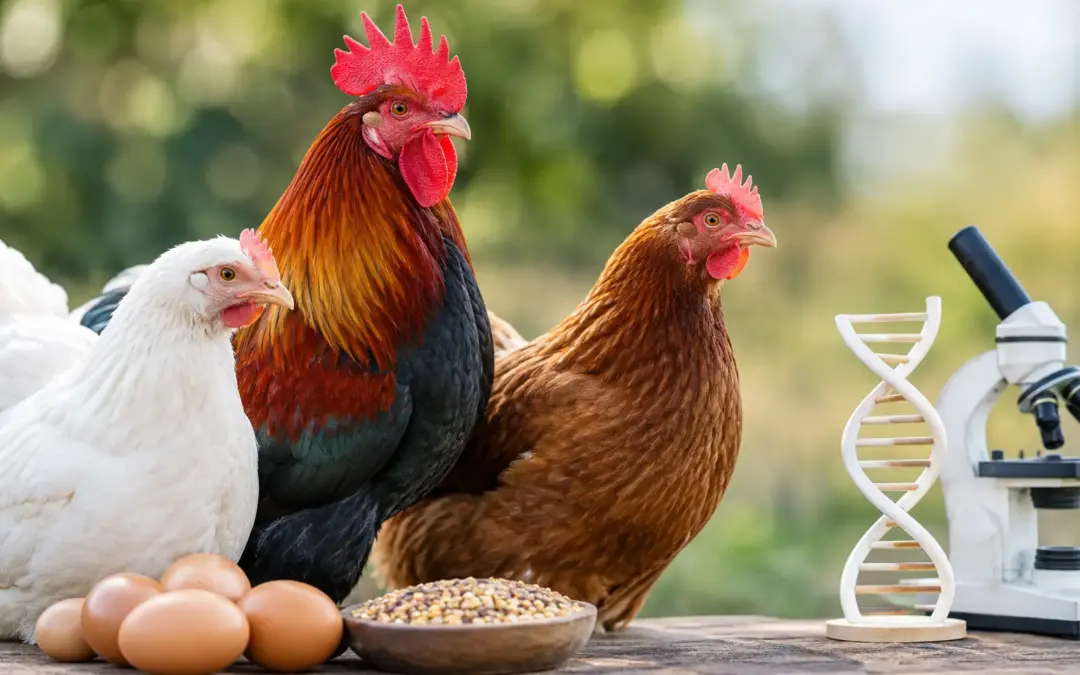
A good guide to breeding chicken genetics starts with a hard truth: a handsome cockerel and a few decent hens are not yet a breeding programme. They are a starting point. Progress comes from knowing what each bird brings to the pen, setting a clear aim, and being honest about what appears in the next generation.
For keepers working with rare breeds, heritage lines or carefully selected utility birds, genetics is not a classroom exercise. It is what determines whether you preserve the qualities that drew you to the breed in the first place, or gradually lose them through unplanned pairings. No noise, just quality stock and decisions you can stand behind.
Start your guide to breeding chicken genetics with a purpose
Before choosing a mating, decide what you are trying to produce. “Better birds” is too vague to guide selection. A useful aim might be to improve lacing in a particular colour variety, retain a broad breast and strong legs in a table breed, improve egg colour without losing type, or preserve a sound old line with enough genetic breadth for the future.
Your target should reflect the recognised breed standard where one exists, but it must also account for health, fertility and usefulness. A bird can be excellent in the show pen yet be a poor breeding prospect if it has weak vigour, poor hatchability, recurring respiratory issues or an unreliable temperament. Equally, chasing production alone can gradually erode the shape, feather quality and character that make a traditional breed worth keeping.
Write down the handful of traits that matter most. Put them in order. If every fault is treated as equally serious, selection becomes muddled. For many breeders, health and vigour belong at the top, followed by correct type, then breed-specific colour or markings. The exact order depends on the breed and your flock, but the discipline of ranking traits is valuable.
Learn what you can see and what you cannot
Every chicken has a genotype, the genetic information it carries, and a phenotype, the bird you can see. The two overlap, but they are not identical. A bird may carry a recessive gene without showing it, while nutrition, housing, disease exposure and age can all influence how strongly a trait is expressed.
Some characteristics are relatively straightforward. A recessive trait appears only when a chick inherits the relevant gene from both parents. A dominant trait may show when inherited from one parent, though expression can vary. Sex-linked traits are inherited differently by males and females, which can make certain crosses useful for identifying chicks at hatch.
Most qualities breeders care about are less tidy. Body shape, laying ability, fertility, temperament, feather quality and resistance to everyday stresses are usually influenced by many genes, as well as management. This is why a single impressive hatch does not prove a pairing is right, and why one disappointing chick does not always condemn a parent bird.
Think in terms of patterns across offspring. If several chicks from different hatches show the same strength or weakness, you have more useful evidence. If a fault appears repeatedly when one bird is used with multiple partners, that bird deserves closer scrutiny.
Choose parents for their whole breeding value
Breeding birds should be mature enough to assess properly and healthy enough to rear strong chicks. Start with sound feet and legs, a well-carried body, clean eyes, good feather condition and active, alert behaviour. Inspect closely for faults that can be passed on or worsened through selection, including poor beaks, crooked toes, weak wings, narrow bodies, low fertility and persistent poor feathering.
Then look beyond the individual. Ask what is known about the bird’s parents, siblings and previous offspring. A cockerel may look outstanding himself but repeatedly throw poor tails, weak colour or fertility problems. A hen with a small visual fault may come from a dependable family that produces well. Pedigree knowledge gives context that a single bird cannot.
Avoid breeding from birds with clear hereditary defects simply because they are rare, productive or attractive in another respect. A scarce line is not helped by multiplying a fault through the flock. Where a problem may be environmental rather than inherited, improve management first and observe the bird over time before making a final decision.
Plan the mating rather than filling a pen
The simplest controlled set-up is one cockerel with a selected group of hens, with eggs labelled by pen and date. This lets you assess the family produced by that mating. If you run several pens, keep equipment and egg collection organised so that records remain trustworthy. A pedigree is only as useful as the identification behind it.
Use complementary pairings carefully. If a hen is slightly weak in one area, choose a mate strong in that area, but do not assume opposite faults cancel each other out. Two birds with different weaknesses can produce offspring carrying both. The aim is to pair sound birds that reinforce the traits you want, not to use one bird as a sticking plaster for another.
Linebreeding, where related birds are mated within a known family, can make desirable traits more consistent. It can also expose hidden weaknesses quickly. That is its benefit and its risk. Close matings demand ruthless record-keeping, high standards of health and a willingness to remove weak individuals from the breeding plan.
An outcross to unrelated, appropriate stock can restore vigour or correct a persistent weakness, but it may introduce unwanted traits and reduce consistency for a generation or two. This is not a failure. It is a trade-off. The best outcross is chosen for a specific reason, from a breeder who can explain the line behind the bird, not simply because it is available.
Keep records that make selection possible
Memory is unreliable once chicks have grown, moulted and moved between pens. Record parentage, hatch date, hatch rate, sex, leg ring number, colour or variety, notable traits, health observations and final breeding decisions. Photographs taken at similar ages are useful, particularly when comparing body shape, markings and feather development.
For each mating, note what you expected and what actually happened. Did the chicks have good vigour? Were the sex ratio and fertility normal? Did a particular fault recur? Which young birds held their type after their first moult? These details turn breeding from guesswork into informed selection.
A practical record does not need to be elaborate. A notebook, spreadsheet or flock cards can all work. What matters is consistency. If you buy hatching eggs or stock, retain the seller’s information and ask sensible questions about parent birds, hatchability and known line traits. Serious breeders welcome informed questions because they protect both their reputation and the birds.
Select hard, but give young birds time
Do not make final decisions too early. Many traits change as a chicken develops. A pullet may tighten in feather, improve in body or reveal laying quality only after she has settled into her first season. Young cockerels can also alter considerably as they mature.
That said, obvious structural faults, poor health and lack of vigour should not be ignored while you wait for a bird to “grow out of it”. Keep the best youngsters long enough for a fair assessment, then reduce numbers with your breeding goal in mind. Retaining every pleasant bird makes it harder to see the standard you are trying to build.
Selection is not about finding perfect chickens. Few exist. It is about choosing the birds that move your flock in the right direction without creating a new problem elsewhere. Keep more than one promising family where space allows. It gives you options if a line later shows reduced fertility, a recurring defect or a trait you no longer wish to reinforce.
Protect diversity, welfare and trust
A closed flock can become very uniform, which is useful up to a point. Too much genetic narrowing, however, can bring reduced hatchability, weaker chicks, poorer fertility and lower resilience. Watch flock performance as closely as appearance. Declining results are a reason to review the family tree, not merely blame the incubator.
Good genetics cannot compensate for poor husbandry. Breeding birds need suitable space, clean dry housing, balanced feed, parasite control and a calm routine. Stress, overcrowding and poor nutrition can distort the results you are trying to measure. Give the birds the conditions to show their real potential.
When selling breeding stock or hatching eggs, describe them accurately. State the breed or variety, the parent stock, known faults if relevant, fertility expectations and whether birds are from a recognised line or simply bred to type. Straight dealing helps buyers make sensible choices and strengthens the specialist community that rare and traditional poultry depend on.
The most useful next step is simple: choose one breeding aim for this season, label every egg from the relevant pen, and start a record before the first chick hatches. A careful note made now can be the difference between repeating a mating and genuinely improving it.