
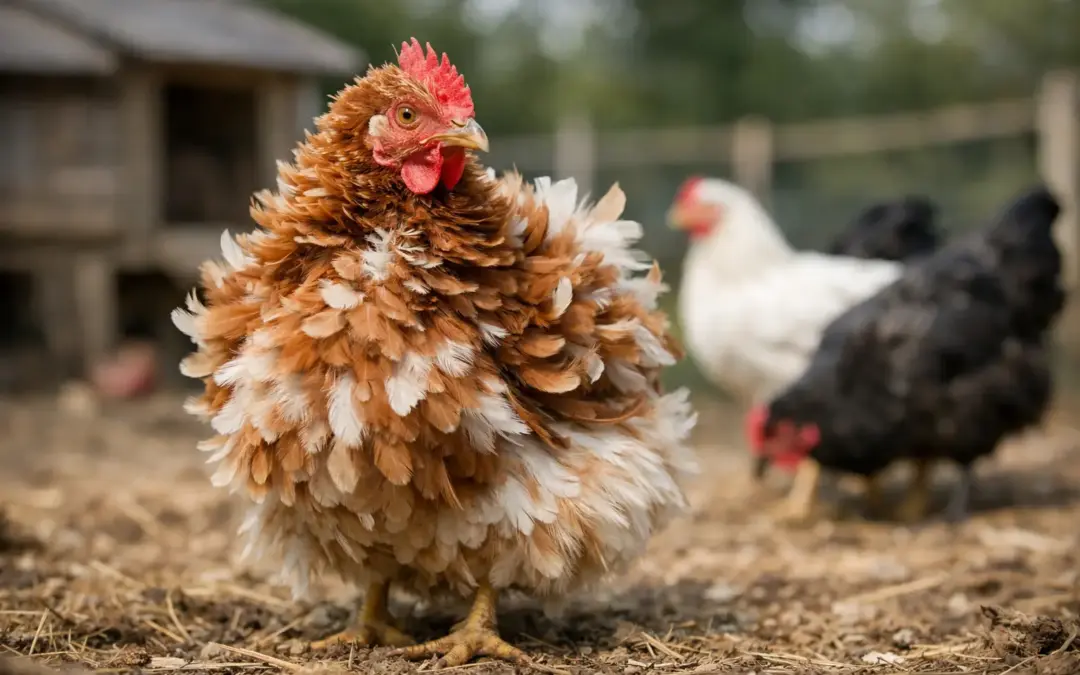
A properly feathered Frizzle is hard to miss. The curled, outward-turning plumage gives the bird a wonderfully untidy outline, but frizzle feathers are more than a showy feature. They affect weatherproofing, breeding decisions and the standard of care that bird needs through the year.
For keepers drawn to unusual poultry, Frizzles can make excellent additions to a well-managed flock. The key is knowing what you are looking at, buying from breeders who understand the genetics, and avoiding pairings that produce weak-feathered birds.
What are frizzle feathers?
Frizzle is a feather type caused by a gene that makes the feather shaft curl outwards instead of lying flat against the body. Rather than being a breed in its own right, it can occur in several breeds and types of chicken, including bantams, Pekins, Polish and larger fowl. You may also see Frizzles described by their underlying breed, such as a Frizzle Pekin.
The effect varies. Some birds have a light, even curl that shows the pattern of the underlying plumage beautifully. Others look far more dramatic, with each feather lifting away from the body. Good frizzling should be obvious without leaving the bird looking sparse, broken or unable to keep itself covered.
A Frizzle can be any recognised colour, and its quality should still be judged on sound type, condition, temperament and breed characteristics. Curly feathers alone do not make quality breeding stock.
The Frizzle gene and why pairings matter
The Frizzle gene is incompletely dominant. In practical terms, a bird carrying one copy of the gene usually has the desired frizzled plumage. A smooth-feathered bird does not carry it.
Problems arise when two Frizzles are mated together. Some offspring may inherit two copies of the gene and develop what breeders commonly call frazzle feathering. These birds can have very brittle, sparse or excessively curled feathers, with poor protection from cold and wet weather. Their feathering may break easily and they are not suitable stock to breed from.
For that reason, the usual responsible pairing is a Frizzle to a sound smooth-feathered bird of the same breed or breeding line. This gives a mixed hatch of frizzled and smooth chicks, while greatly reducing the risk of producing frazzles. The smooth birds are not unwanted by-products – they are valuable to a sensible breeding programme and should have the same health, type and temperament standards as their frizzled siblings.
If you are buying hatching eggs or a breeding pair, ask plainly how the parents are paired. A breeder who can explain the line, the parent birds and their expected outcomes is offering far more than a pretty photograph.
Keeping Frizzles comfortable outdoors
Frizzle feathers do not shed water or trap warmth as efficiently as normal plumage. That does not mean every Frizzle must live indoors, but it does mean their housing and range need closer attention, particularly in a British winter.
A dry, draught-free coop is non-negotiable. Ventilation still matters, but cold air should not blow directly across roosting birds. Give Frizzles a roofed area outside where they can scratch and feed without becoming soaked, and make sure the pop-hole, bedding and perches stay dry. A bird that repeatedly gets wet and chilled will struggle, however good its breeding may be.
Check feather condition regularly. Mud, lice, mites and feather damage are more visible on a Frizzle, but they can also be harder for the bird to manage through normal preening. During the moult, their coverage may look especially poor. Extra shelter, good-quality feed and minimal handling help them put new feathers on without unnecessary stress.
Frizzles can also be more vulnerable to bullying if they look conspicuously different or cannot fly as well as their flock mates. Introduce them carefully and watch the pecking order rather than assuming a friendly breed name guarantees a peaceful flock.
Choosing Frizzle stock worth keeping
The best Frizzle is not simply the curliest bird available. Look for clear eyes, clean nostrils, strong legs, good body weight and tidy feather condition. Ask whether the bird has lived outside, how it copes in wet weather, and whether either parent showed brittle or thin plumage.
For breeders, photographs of adult parent stock are useful, but direct questions matter more. Establish the breed, age, breeding pairing, vaccination or health history where relevant, and whether the birds have been raised as part of a closed or regularly tested flock. Serious sellers should welcome those questions.
At Hatch & Hive, specialist listings make it easier to start with the details that count: breeding quality, parentage and a direct conversation with the keeper behind the stock. Frizzle birds deserve that level of care, because the right feather gene is only one part of a healthy, useful chicken.
A Frizzle kept dry, fed well and bred from thoughtfully is not a novelty bird. It is a striking, characterful member of the flock – and one that rewards keepers who take its feathering as seriously as its pedigree.