
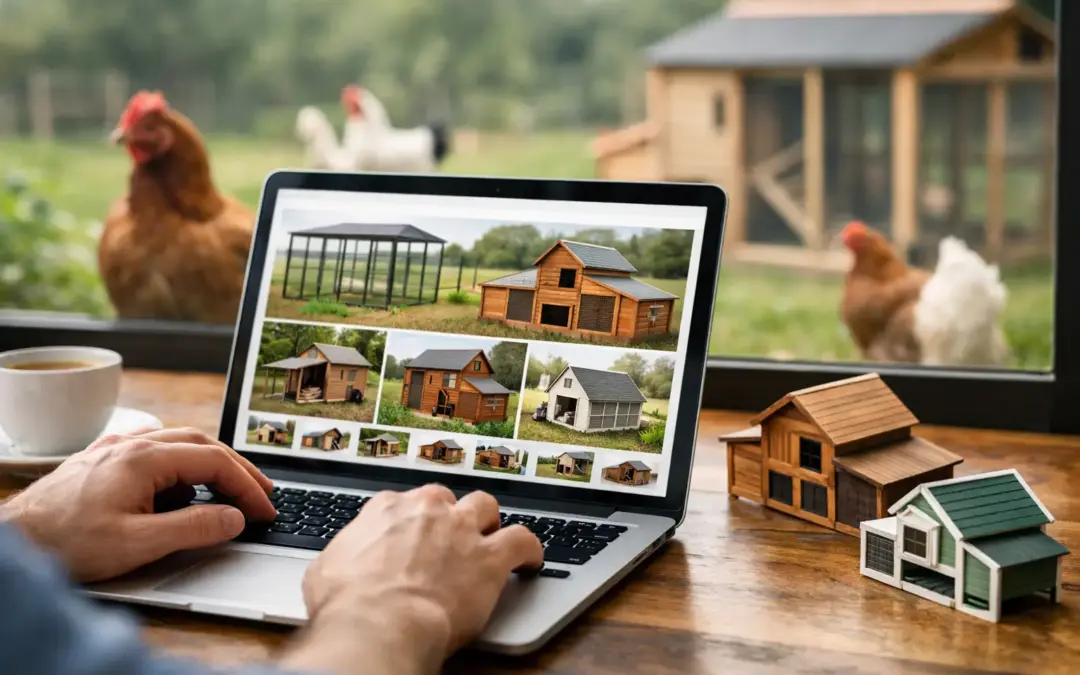
A smart-looking coop can be a costly mistake if it is too small, impossible to clean or built from timber that will not survive its first wet winter. When you buy poultry housing online, the photographs are only the starting point. The details that matter are floor space, ventilation, predator resistance, cleaning access and whether the housing actually suits the birds you keep.
For a few garden hens, an enclosed coop and run may be the right answer. For a breeding pen, a mobile ark or separate houses for distinct lines may make far more sense. No noise, no guesswork – start with the flock, then assess the housing.
Buy poultry housing online with the flock in mind
The first question is not, “Which coop looks best?” It is, “What must this housing do?” A house for three quiet bantams has very different demands from one for a large-fowl breeding trio, a cockerel and hens, growing growers, or a mixed flock that needs to be managed carefully.
Seller capacity claims deserve a close read. They often assume small, lightweight birds and ideal conditions. Large breeds need more room to perch, turn and settle without being crowded. Birds also spend more time inside during poor weather, confinement periods or when you are managing introductions. Buying the smallest house that technically fits the advertised number is rarely the economical choice.
Think about your likely next step, too. Keepers often start with six hens and soon find themselves hatching a favourite breed, retaining promising pullets or separating a breeding group. A slightly larger, well-designed unit can be better value than replacing an undersized coop after one season. That said, bigger is not automatically better if it leaves you with a structure you cannot move, clean or position properly.
Match the housing type to the job
A fixed wooden coop can suit a permanent garden set-up, particularly when paired with a secure covered run. It is often more attractive and can provide generous internal space, but it needs a dry base, regular timber care and good protection at ground level.
An ark is useful where birds are moved onto fresh ground. It can be practical for growers or breeding groups, provided it is substantial enough for the weather and predator pressure on your site. Lightweight models are easy to move but can be vulnerable to wind and may offer limited room for larger birds.
Plastic housing is popular for straightforward wash-down cleaning and reduced red mite harbourage. It is not automatically superior in every setting. Check how it performs in direct sun, whether replacement parts are available and whether the shape provides enough usable perch and nest-box space.
Walk-in houses and sheds offer serious flexibility for established keepers. They can accommodate more birds and make daily work easier, but they require sensible siting, sound flooring, secure mesh and a realistic plan for cleaning. A large building with poor ventilation is still poor poultry housing.
The details photographs do not always show
Good online listings should make it possible to judge the build, not simply admire it. Ask for measurements in centimetres, including internal floor dimensions and headroom, rather than relying on a broad description such as “suitable for up to six chickens”. If dimensions are not clear, ask before arranging collection or delivery.
Pay particular attention to access. You need to reach every corner of the sleeping area without dismantling half the house. A removable droppings tray, wide opening roof or full-height access door can turn a difficult weekly task into a quick one. Nest boxes should be accessible from outside, but their lids must close firmly and shed rain.
Ventilation should be high enough to avoid draughts directly over roosting birds while allowing warm, damp air to escape. Condensation, stale air and wet litter create problems quickly. Small decorative vents are not necessarily enough, especially in a full house during winter.
Roosting arrangements matter more than they are given credit for. Perches should allow birds to settle comfortably without jostling for space, and should be removable or easy to scrub. Inspect the listing for sharp edges, narrow dowels and awkward fixed perches that trap dirt. For heavy breeds, sensible perch height and an easy route up are kinder on feet and legs than lofty bars designed for a showroom image.
Check security before you check out
Foxes, rats and determined urban wildlife do not care whether the coop was expensive. Security comes from the whole set-up, not a padlock on the pop hole.
Look at the construction around hinges, catches, roof joins and the base. Thin felt, flimsy staples and lightweight wire may be adequate only with substantial additional protection. If a listing includes a run, establish exactly what mesh is used and whether it is suitable for your local predator risk. Welded mesh is generally a stronger proposition than chicken wire for a permanent boundary, while the lower edge may need an apron, buried protection or another secure solution depending on the ground and site.
Automatic pop-hole doors can be helpful for busy households, but they are not a substitute for checking birds are safely in at dusk. Confirm the door opening size suits your birds, how it is powered, and whether it can be operated manually if a battery fails. A reliable routine remains part of good husbandry.
Weatherproofing deserves the same scrutiny. Ask whether timber has been treated, what the roof material is, how water is directed away from openings and whether the house is raised off wet ground. In much of the UK, a coop that is merely water-resistant on a product page will be tested hard by wind-driven rain and prolonged damp.
Questions worth asking a poultry housing seller
A specialist seller should expect practical questions. It is better to have a short conversation before purchase than discover missing parts, impractical access or a misleading capacity once the housing arrives.
Ask whether the listed measurements are internal or external, what is included in the price, and whether the unit arrives assembled, in panels or flat-packed. Clarify the delivery arrangement or collection requirements. A large assembled coop may need more than a standard car and an extra pair of hands at the other end.
For used housing, ask its age, why it is being sold, whether it has had a red mite issue, and how it has been cleaned and treated between occupants. Used housing can be excellent value, especially if it is well-built, but it needs an honest condition report. Look closely at floor corners, perch ends, roof voids, joints and felt edges – all are places where pests and moisture can take hold.
It is also worth asking for current photographs rather than relying on older manufacturer images. A direct buyer-seller marketplace gives you room to ask those questions properly. On Hatch & Hive, that specialist context matters: you are speaking with people who understand the difference between a decorative garden coop and housing expected to work through a breeding season.
Plan the site before the housing arrives
The best house performs poorly if it is placed in the wrong spot. Choose well-drained ground where possible, with shelter from prevailing weather but enough daylight and airflow to keep the area dry. Avoid low points where water pools. A level base makes doors, removable trays and automatic systems work as intended.
Allow working space around the house. You will need room to open access panels, carry bedding, move feed bins and inspect the back of the unit. Consider your route from the house to the compost area as well. A coop positioned beautifully at the far end of a muddy garden becomes less appealing on a dark January morning.
If you are adding new housing to an existing flock, think through quarantine and separation before birds arrive. Separate accommodation is useful for introductions, breeding programmes, broodies and unwell birds, but it must still offer proper shelter, security and daily attention. Temporary housing has a habit of becoming permanent.
Delivery, assembly and the true cost
The price on the listing is not always the final figure. Factor in delivery, fuel for collection, a base, fixings, weatherproof treatment, mesh upgrades and bedding. Flat-pack housing can offer good value, but only if you have the tools, time and confidence to assemble it squarely. A poorly fitted roof or misaligned door quickly cancels out the saving.
Read the seller’s description for lead times and any access restrictions. Rural deliveries, narrow lanes and heavy panels can all affect the practicalities. If collection is offered, measure the vehicle first. It sounds obvious, but a coop that will not fit through a side gate or into a trailer is a problem best solved before payment.
The right poultry housing should make care easier, give birds dry and secure rest, and leave you enough capacity to manage the flock well. Choose the house you can inspect, clean and trust when the weather turns. Your birds will tell you soon enough whether you got it right.