
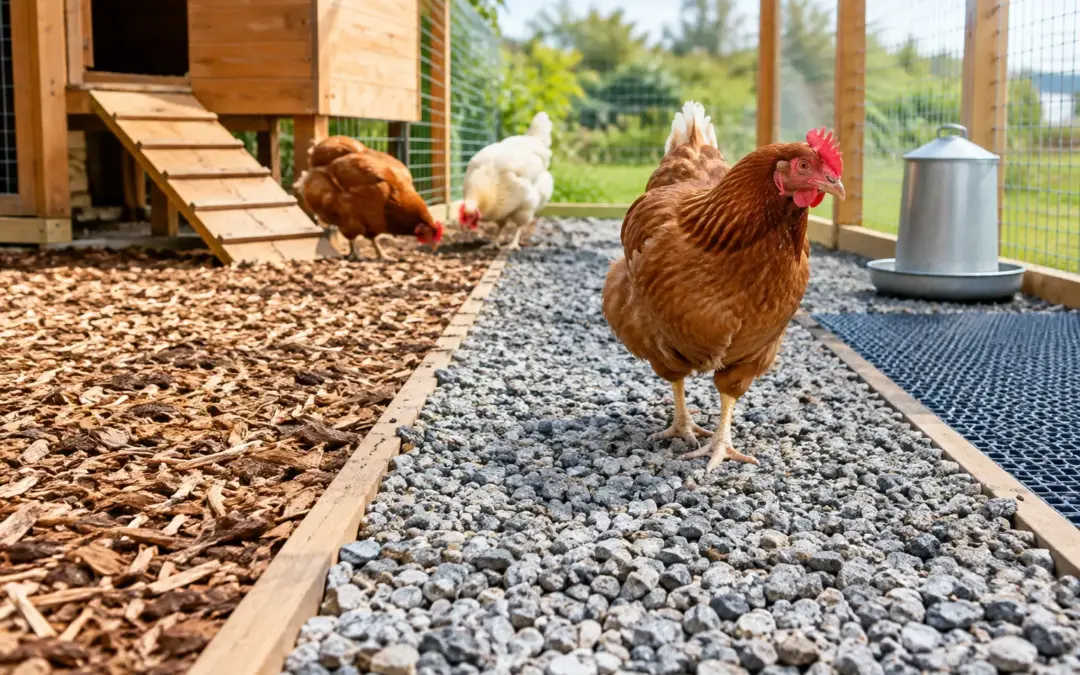
A chicken run can look perfectly sound in August, then turn into a wet, compacted mess after a fortnight of rain. That is why choosing the best chicken run flooring is less about making the run look tidy and more about drainage, clean feet, dry bedding and a surface your birds can properly use.
There is no single material that suits every flock or plot. A small movable run on free-draining ground needs very little intervention. A permanent covered run housing valuable breeding birds through a British winter needs a proper base and a surface you can maintain without constantly fighting mud.
What good chicken run flooring must do
The right floor should drain well, give birds room to scratch and dust-bathe, and be practical to rake out or replace. It should not hold standing water, turn greasy under droppings, or leave hens walking through mud before they return to the coop.
Think about the whole system rather than the top layer alone. If the ground beneath the run is saturated clay, a fresh load of chip may look good for a few weeks but will eventually sink into the mud. If roof water pours off the run into one corner, even the best surface will struggle. Gutters, a slight fall away from the coop and enough covered area often make more difference than the material itself.
For a permanent run, build from the ground up: stable sub-base, dependable drainage, then a bird-friendly surface. For temporary or rotational runs, prioritise a surface that can be moved, rested and allowed to recover.
Best chicken run flooring for most permanent runs
For many UK keepers, the most reliable answer is a well-drained base topped with clean woodchip. It gives birds a forgiving, interesting surface to scratch through, copes well with droppings, and is straightforward to top up or remove when it has broken down.
The key is using the right chip and putting it on ground that can drain. Coarse arborist chip is often a sensible choice, particularly mixed broadleaf chip that has not been treated, painted or contaminated. Avoid fine sawdust, which can become damp and compacted, and avoid chips from unknown sources where the timber may have been chemically treated. Cocoa shell mulch is also a poor choice around poultry.
A layer around 10 to 15 cm deep usually gives enough material for active scratching without disappearing immediately. In very wet areas, a deeper layer may be needed, but depth is not a substitute for drainage underneath. Rake out the worst soiled patches regularly, especially around feeders, drinkers and the coop door, then top up as needed.
Woodchip will gradually compost. That is not a failure – it is simply the point at which it needs removing and replacing. Once safely composted away from the flock, the old material can be valuable on an ornamental border or around established fruit trees.
Build the base before adding the chip
On a wet or heavily used permanent run, lift the turf and create a firm, draining foundation. A compacted layer of suitable aggregate provides stability, while a geotextile membrane beneath it helps prevent the underlying soil from working its way up into the base. Finish with woodchip on top.
Do not leave membrane exposed where birds can peck and tear at it. It is a structural layer, not a walking surface. Also avoid creating a sealed bowl beneath the run. Water needs somewhere to go, whether that means a slight slope, a land drain where appropriate, or a run positioned away from naturally boggy ground.
This takes more effort at the outset, but it saves repeated loads of surface material and protects the ground around the coop. For a fixed breeding set-up, it is usually money well spent.
Other chicken run flooring options, honestly assessed
Woodchip is not automatically the best choice for every set-up. The following options all have a place, provided you understand their limits.
Bare earth and grass
A large run with a modest number of birds can work well on natural ground, especially if it is regularly rested or moved. Chickens enjoy soil, plants and insects, and grass offers genuine enrichment while it lasts.
The difficulty is stocking density. A few hens can strip a small run to bare earth remarkably quickly, particularly in winter. Once grass has gone, the soil compacts and mud follows. Keep bare ground for rotational or spacious runs, not a small permanent pen that sees daily traffic.
Washed sharp sand
Washed sharp sand can be easy to rake, dries quickly in a roofed run and makes spotting droppings simple. Some keepers favour it for compact covered areas where they can sieve it regularly, rather than for a large open run.
It does have drawbacks. Sand can compact if it stays wet, blow about when dry and become cold or dusty in exposed conditions. It is also not the same as builders’ sand, which is finer and more prone to compaction. If you choose sand, use properly washed sharp sand and keep it under good cover.
Gravel
Gravel is useful as part of the drainage and sub-base, but it is rarely the most comfortable finished surface for a run. Larger angular aggregate is hard underfoot, awkward to clean and offers little opportunity for natural scratching. Small rounded stones may be swallowed by curious birds and can be difficult to manage in a mixed-age flock.
A thin layer of fine gravel can suit a very high-traffic entrance or a narrow service path, but it is better treated as a practical support material than the main floor where birds spend their day.
Concrete or paving slabs
Concrete and slabs are durable, rat-resistant and simple to wash down. They can make excellent flooring beneath a covered feed station, in a quarantine pen or in a purpose-built breeding block where biosecurity and cleaning matter most.
For a full run, though, hard flooring needs managing. It must be laid with a fall so water drains away, and it should be covered with a loose material such as woodchip or sand to give birds a kinder surface. Bare concrete offers little enrichment and can leave the run unpleasantly cold and stark. A hard base plus a replaceable top layer is a much better arrangement.
Rubber mats
Rubber matting is useful at the coop threshold, on a sheltered perch landing area, or in a small hospital pen. It is not a convincing whole-run solution. Mud and droppings still need removing, wet mats can become slippery, and chickens cannot scratch or forage naturally on them.
Match the floor to the pressure points
Most flooring failures start in the same places: beneath drinkers, around feeders, at pop-hole exits and along the route birds take when they see you arrive with food. Deal with those areas directly.
Raise drinkers on blocks, a low stand or a stable platform so spilled water does not soak the surrounding floor. Put feeders under cover and move them occasionally. Add an extra patch of fresh chip at the coop door before it becomes a crater. These small jobs are far more effective than waiting for the entire run to deteriorate.
Roofing part of the run is equally valuable. A dry covered section gives birds somewhere to stand during prolonged rain and preserves a clean area for feed and water. It also makes winter husbandry considerably easier. In exposed parts of the UK, a covered run is often the difference between maintaining a surface and continually replacing one.
Hygiene, worms and practical maintenance
No flooring material makes a run self-cleaning. Regular droppings removal, dry feed stations and sensible stocking levels remain the basics. A floor that looks clean but stays damp can still create poor conditions around feet and feathers.
Woodchip should be raked to break up compacted areas and checked for wet, dark material beneath the surface. Sand should be poo-picked or sieved frequently. Hard floors need washing only when they can dry fully afterwards, rather than being left wet in cold weather.
If you are bringing in new birds, using a separate, easy-clean quarantine space is wiser than relying on the main run surface to manage disease risk. The same principle applies to valuable breeding groups: good flooring supports welfare, but it does not replace careful observation, clean equipment and sensible flock management.
A sensible choice for your flock
For a small permanent run on wet ground, start with drainage and a stable base, then use untreated coarse woodchip as the working surface. For a covered breeding pen, sharp sand or chip over a hard, sloped base can be easier to keep orderly. For a large rotational run, let the birds use natural ground and protect it by moving them before it is stripped bare.
The best floor is the one you can keep dry, clean and workable through February, not the one that looked smartest on the day it was laid. Build for your soil, your flock numbers and the way you actually keep birds. Your hens will tell you quickly when you have got it right: clean feet, busy scratching, and no queue of miserable birds trying to avoid the mud.