
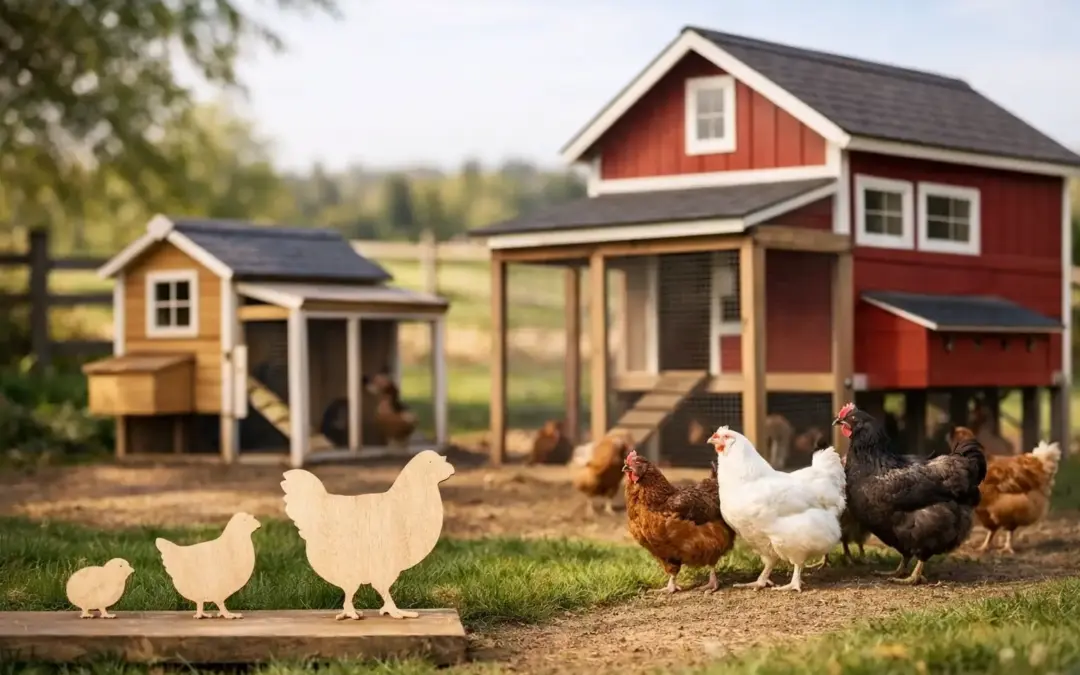
Too small, and the birds tell you quickly. Pecking starts, nest boxes turn into sleeping spots, the floor is filthy by morning, and what looked like a tidy coop on a product page suddenly feels mean. If you are asking which coop size do I need, the honest answer is not a single number – it depends on your birds, your run, and how you actually keep them.
A coop is not just a box to shut hens into at night. It is their roosting space, shelter, laying area and, in a British winter, often the difference between a flock that stays settled and one that becomes hard work. Get the size right at the start and life is easier for both keeper and birds.
Which coop size do I need for the number of birds?
The quickest way to judge coop size is to separate indoor sleeping space from outdoor run space. Sellers often blur the two. A coop may be advertised for six hens, but that figure usually assumes a generous run, regular free ranging and calm, average-sized birds. In real keeping conditions, especially in wet UK weather, that headline number can be optimistic.
As a practical guide, standard laying hens usually need around 3 to 4 square feet of internal coop floor space per bird if they are shut in overnight only and have proper access to a run during the day. Bantams need less, often around 2 square feet each, while large fowl such as Orpingtons, Brahmas or Cochins need more room than lightweight hybrids.
For the run, many keepers work on at least 10 square feet per standard hen as a bare minimum. More is better, especially if the birds spend long periods enclosed. If your flock is not free ranging daily, then generous run space matters just as much as the coop itself. In truth, a roomy run often prevents more problems than a larger house alone.
That means a flock of four medium hens might be comfortable with roughly 12 to 16 square feet inside the coop and at least 40 square feet in the run. For six hens, you are looking at something closer to 18 to 24 square feet inside and 60 square feet or more outside. If you keep heavier breeds, increase that.
Why the advertised capacity can be misleading
Anyone who has kept poultry for more than a season knows that coop capacity labels can be generous to the point of comedy. The stated number may be based on birds packed onto perches with little spare room, minimal head height and not much thought for muddy weeks when the flock does not want to stand outside.
There is also a difference between what birds can tolerate and what works well. Yes, hens often huddle close on the perch in cold weather. No, that does not mean a cramped coop is suitable. Crowding drives stress, and stress turns into feather pecking, squabbling over nest boxes and a generally unsettled flock.
A decent rule is to treat advertised numbers as the top end, not the target. If a coop says it suits six hens, many experienced keepers would call it comfortable for four medium birds or perhaps five at a push, depending on the run and breed.
Breed size changes everything
This is where the question which coop size do I need becomes more specific. Four Leghorn-type hens and four Buff Orpingtons do not use space in the same way. One flock is light on its feet and narrow-bodied. The other is broad, heavy and takes up perch room quickly.
Bantams are easier to house in terms of square footage, but they can still fall out if the setup is poorly planned. Large fowl need wider pop holes, sturdier perches and more turning room inside. Cockerels, if you keep one where permitted and practical, also add to the space requirement, both physically and socially.
Mixed flocks need a bit of thought. If you keep bantams with standard hens, make sure perch heights and access suit both. If you keep heavier breeds, low perches with enough width are usually better than tall, narrow arrangements. Coop size is not only about floor area. It is also about whether the internal layout actually works for the birds you own.
The measurements that matter inside a coop
Floor space is the starting point, but it is not the whole story. Perch length matters just as much because most hens want to roost properly at night. As a guide, allow around 20 to 25 cm of perch space per standard hen, and a bit less for bantams. Heavier breeds often need more elbow room, if hens can be said to have elbows.
Nest boxes are another point people get wrong. You do not need one box per hen. One nest box for every three hens is usually fine, because they will all insist on laying in the same one anyway. What matters more is that boxes are darkish, dry and not directly under perches where droppings will land.
Ventilation is non-negotiable. A bigger coop with poor airflow is worse than a slightly smaller one with proper high-level ventilation. Damp, stale air causes more trouble than cold in most British setups. If condensation is forming inside, the house is not working as it should.
Headroom helps too. A coop that allows you to clean it properly will save time and patience. If you have to dismantle half the structure to scrape out bedding, it will become a chore, and neglected housing never stays a small problem.
Which coop size do I need if my hens stay in the run all day?
If your birds are not free ranging much, err on the generous side with both house and run. This is where many first-time buyers under-size. They imagine the hens will only sleep inside, but in reality birds often shelter in the house during wind, rain, heat or bullying.
A run-only system can work very well, but only when space is honest. For confined birds, more run room means cleaner ground, lower stress and fewer behavioural issues. Covered runs are especially useful in the UK because they keep part of the ground drier and stop the whole enclosure turning into a churned patch of mud by November.
If your flock free ranges for most of the day on decent ground, you may get away with a coop closer to the standard recommendations. If they spend winter penned because of weather, garden limits or biosecurity concerns, build in extra room from the start. Future-you will be grateful.
Planning for growth, not just today
Most people do not stop at the exact number of birds they first planned. Three hens become five. A trio of rare breed growers stays because one pullet turns out especially good. A spare coop gets filled. That is normal poultry keeping.
So when asking which coop size do I need, ask a second question as well: what will I wish I had bought in six months? If the answer is something slightly bigger, buy once and buy sensibly. It is usually cheaper than upgrading after one wet season and a pecking outbreak.
That does not mean buying absurdly large housing for a tiny flock. Hens still like to feel secure, and oversized empty spaces can be draughty if badly designed. It means leaving sensible headroom for one or two extra birds and choosing a setup with a run that can be extended.
Common sizing mistakes keepers make
The biggest mistake is trusting marketing numbers without checking actual dimensions. Always look at internal floor measurements, not just external footprint. Nest boxes that jut out from the side do not count as living space.
The second mistake is forgetting breed size. Heavy birds, feather-legged breeds and broad-bodied table strains need more room than commercial hybrid layers. The third is ignoring winter reality. A setup that feels acceptable in July can be miserable in January.
Another common issue is over-focusing on the coop and underestimating the run. A decent house with a cramped run often leads to more problems than a modest house attached to a proper enclosure. If the budget forces a choice, avoid squeezing too many birds into too little outside space.
A practical way to choose the right size
Start with the flock you actually keep or plan to keep. Count the birds, note whether they are bantams, medium hybrids or large fowl, and be honest about how much free range time they will get. Then check three things: internal floor area, perch length and total run space.
If any one of those looks tight, move up a size. Do the same if you live in an exposed area, keep birds penned through winter, or want room to add to the flock later. Good housing should feel workable on your worst day, not just on a sunny afternoon when everything looks fine.
For many back garden flocks, the sweet spot is slightly larger than the entry-level coop people first consider. That extra bit of room improves cleanliness, bird welfare and keeper sanity. It also makes quarantine, temporary separation and introductions much easier when real life intervenes.
If you are buying from a specialist marketplace such as Hatch & Hive, use that advantage properly. Ask the seller what type of birds the coop has actually housed, whether the stated capacity is for bantams or standard hens, and how it performs in wet weather. Serious poultry people usually give a far more useful answer than a generic product label ever will.
The right coop is the one that gives your birds enough room to roost, breathe, settle and stay clean without forcing you into constant compromise. If you are hesitating between two sizes, the larger honest option is usually the better call.