
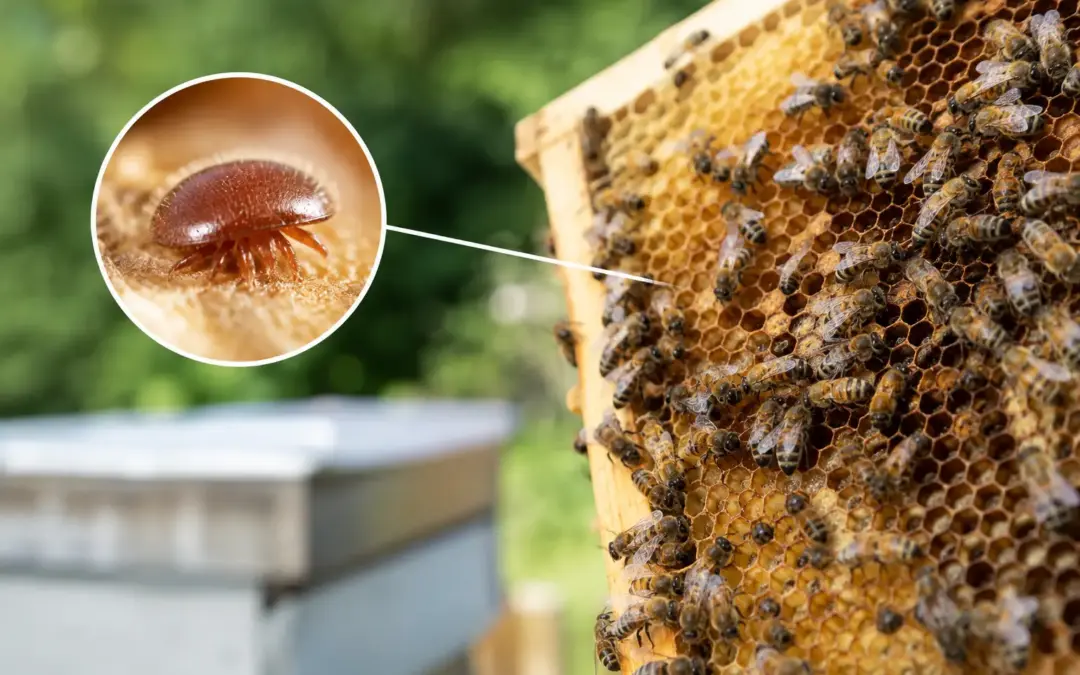
A colony can look busy at the entrance and still be carrying a damaging varroa load. By the time bees with crumpled wings appear on the landing board, the problem has usually been building inside the brood nest for weeks. Varroa mites and treatment are therefore not a once-a-year box-ticking exercise. They are part of the ordinary husbandry that keeps productive colonies alive, healthy and worth breeding from.
Why varroa changes the whole colony
Varroa destructor reproduces beneath capped brood, with a particular preference for drone brood where it has more time to develop. Adult female mites then travel on adult bees, feeding and moving through the colony. The visible mite is only part of the issue. Varroa also spreads and amplifies viruses, especially deformed wing virus, turning what might have been a manageable infestation into a rapid late-season decline.
This is why a strong honey crop does not prove a colony is healthy. Colonies often look at their best in summer while mite numbers are rising alongside brood production. The real damage frequently lands later, when the colony is trying to raise its long-lived winter bees. If those bees emerge virus-affected or weakened by mite feeding, a colony may dwindle through autumn or fail before spring forage arrives.
No stock can be assumed varroa-proof. Some lines show useful hygienic behaviour or cope better than others, and that is worth selecting for, but good genetics do not remove the need to monitor. Serious beekeeping means knowing what is happening in each box, not hoping the bees have handled it.
Varroa mites and treatment start with monitoring
Treating every colony on the same date without checking mite levels can waste a useful medicine, select for resistance and miss the colony that needs action first. Monitoring gives context. It tells you whether a treatment has worked, whether a colony is repeatedly under pressure and whether a newly acquired colony needs closer attention.
An alcohol wash is widely regarded as the most reliable practical method for estimating infestation. A measured sample of adult bees, usually taken from a brood frame where nurse bees are present, is washed so the mites can be counted. It is not a pleasant task because the sampled bees are sacrificed, but it gives a much clearer figure than guessing from the entrance.
A sugar roll may be used by keepers who do not want to kill a sample, though it can underestimate the number of mites present. Uncapping drone brood can reveal active reproduction and is a useful training exercise, but it is a snapshot rather than a colony-wide count. Natural mite drop boards can help track a trend over time, particularly after treatment, yet a low drop is not proof of a low infestation.
Monitor more than once through the active season. The most useful moments are during spring build-up, in mid-summer before the main autumn treatment decision, and after treatment to check the result. Keep a record for each colony: sampling date, method, count, treatment used, dates applied and what you saw afterwards. That notebook becomes valuable breeding and management information, not paperwork for its own sake.
Build a treatment plan around the colony calendar
The right control depends on the season, brood status, temperature, honey supers and the product label. There is no honest one-size-fits-all answer. A treatment suited to a broodless colony in December may be poorly timed or ineffective in a brood-heavy colony in August.
In the UK, the pivotal point is often immediately after the honey crop is removed. Colonies may still look large, but they are beginning to produce the bees that must carry them through winter. Leaving a substantial mite burden untreated until later can mean those winter bees are compromised before any medicine goes on.
Use an authorised veterinary medicine and follow its Summary of Product Characteristics and label exactly. That includes dose, timing, temperature range, application period, withdrawal requirements and whether supers must be removed. Do not improvise concentrations, extend a course because it feels safer, or combine products unless the manufacturer specifically permits it. More treatment is not automatically better treatment.
A sound annual plan usually combines a main late-summer or early-autumn intervention with a winter broodless treatment where appropriate. The details depend on local forage, your honey schedule and colony condition. Coastal areas with late ivy, for example, can have a different practical timetable from an inland apiary where the nectar flow ends earlier.
Know what each treatment can and cannot do
Thymol-based treatments can be useful in warmer conditions, but their performance is affected by temperature and ventilation. They may not suit every period of unsettled weather, and colonies can react differently depending on strength and space.
Synthetic acaricides can be highly effective when used correctly, but repeated use of the same active ingredient creates selection pressure. Resistance is not an abstract concern. If treatment results are poor, do not simply repeat the same product without investigating whether brood, timing, application or resistance is the cause.
Formic-acid products can reach mites in capped brood, which is a valuable advantage when brood is present. They also demand careful attention to ambient temperatures, colony size and label instructions. They are not a casual option to put on and forget.
Oxalic-acid treatments work best when little or no sealed brood is present, because mites under cappings are protected. This makes a winter application particularly useful for many colonies. Some keepers use brood interruption methods to create a broodless period in summer, but that is more labour-intensive and can interrupt colony growth. It may suit a controlled breeding programme or a small number of closely managed hives, rather than every apiary.
Rotate treatment types where practical, guided by local advice, product availability and your own monitoring results. Rotation is not just swapping brands. It means avoiding repeated reliance on the same active ingredient and checking whether your chosen method actually reduced mite levels.
Management that makes treatment work better
Medicines work best when the rest of the apiary is orderly. Avoid allowing colonies to collapse from mites, as drifting and robbing can spread mites and viruses into neighbouring colonies. Unite weak, failing colonies when appropriate rather than nursing a hopeless box through autumn. Keep equipment clean, replace very old comb steadily and make sure each colony has enough stores and a queen worth keeping.
Requeening can be part of the answer where a colony is persistently weak, defensive or prone to poor brood patterns. It is not a direct mite treatment, but a young, productive queen helps a colony recover from pressure and gives you a chance to select from your better-performing stock. If you are breeding queens or selling nucleus colonies, record varroa management alongside temperament, laying pattern and disease history. Buyers deserve clear answers.
New colonies, swarms and purchased bees should be assessed rather than assumed clean. A swarm may have a temporary break in brood, which can reduce mite reproduction, but it is not guaranteed to be mite-free. A nucleus with healthy-looking brood still needs monitoring after it settles.
Avoid the shortcuts that cost colonies
Do not wait for deformed wings before acting. Do not rely on a single natural mite-drop count. Do not treat with unlicensed home mixes or products intended for another purpose. And do not leave honey supers on when a product label says they must be removed.
The other costly shortcut is treating without checking afterwards. A follow-up sample is how you find application errors, resistance concerns or rapid reinfestation from nearby colonies. It also tells you when a colony needs a different approach rather than another hopeful round of the same one.
For keepers sourcing bees, a straightforward question about varroa monitoring and treatment history is a mark of good practice, not mistrust. On a specialist community such as Hatch & Hive, that kind of honest husbandry information helps good breeders stand apart from vague listings and protects the wider bee community.
A well-managed colony is not one that has never seen a varroa mite. It is one whose keeper measures the pressure, acts at the right time and leaves the bees strong enough to meet the next season on their own terms.