
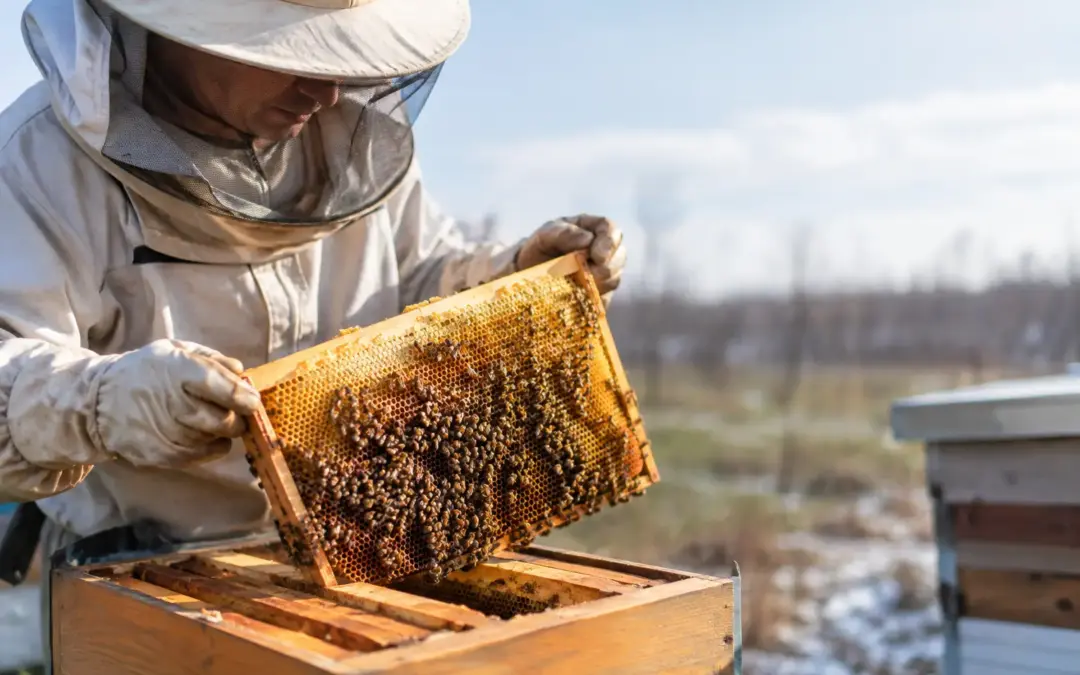
A heavy super at the end of summer is satisfying. It is also where good beekeepers can make an expensive mistake. The last honey harvest before closing down for winter is not about taking every frame the bees have filled. It is about taking a clean, ripe crop while leaving a colony with enough time, food and health to reach spring strongly.
In the UK, that decision is rarely tied to one fixed date. Weather, forage, colony size, hive type and your local autumn flow all matter. A strong colony on a good late flow may continue to bring in nectar well into September. Another, just a few miles away, may have already stopped building stores. Read the hive in front of you, not the calendar on the kitchen wall.
Decide what belongs to you and what belongs to the bees
Before lifting a single super, inspect the brood box properly. You are looking for a viable queenright colony, a sensible brood pattern for the time of year and enough stores around the brood nest to support the bees while you prepare them for winter.
A colony needs substantial usable stores, not merely a few attractive frames of honey at the edge of the box. As a broad guide, many UK beekeepers aim for around 18-25kg of stores going into winter, but that is not a universal rule. A large colony in a cold, exposed area may need more. A smaller colony, a poly hive or a sheltered urban apiary can behave differently. Hive weight, rather than frame counting alone, is often the more honest measure.
Do not assume a full super means the brood box is well provisioned. Bees will store nectar wherever there is room, and a colony can appear prosperous above while being short of sealed food around the brood. If the brood box is light, leave more honey or plan to feed promptly once the crop is off.
The simplest principle is sound: harvest surplus only. If taking a super leaves you wondering whether the bees have enough, it was not surplus.
Choose the right moment for the final harvest
For much of England and Wales, the main summer crop is removed from late August into early September. That timing gives you a clear run at varroa treatment and autumn feeding before temperatures fall. In northern areas, upland sites and more exposed parts of Scotland, the practical window may be earlier. A mild southern site with reliable late forage may allow a little more flexibility.
Heather changes the picture. If you are taking a ling heather crop, the harvest can be later and the honey needs different handling because of its jelly-like consistency. Ivy is another complication. It can provide valuable autumn forage for bees, but ivy honey sets very quickly in comb and can be difficult to extract. Whether you leave it for the colony or take it depends on its position, the colony’s overall stores and your management plan.
What should not be delayed is the health work that follows. If you wait for the last possible drop of nectar and then find your varroa treatment needs several weeks, you may be treating too late to protect the bees that must live through winter.
Harvest only ripe honey
Honey for extraction should be properly ripened. Frames that are mostly capped are the straightforward choice. Uncapped nectar may still be too wet, and extracting it too early raises the risk of fermentation in storage.
A shake test can help with lightly uncapped frames: hold the frame flat and give it a firm downward shake. If nectar falls out, it is not ready. Even then, use judgement. A refractometer is useful when you want certainty, particularly in a damp season or where your honey has a high proportion of late nectar.
Avoid taking brood frames simply because they contain honey. The brood box is the colony’s winter larder and nursery. Keep the harvest to genuine honey supers unless you have a clear reason and enough experience to manage the consequences.
Get the supers off without starting a robbery
Late summer is a tense period around an apiary. Nectar may be scarce between flows, wasps are active and every opened hive can attract attention. Work cleanly and with purpose. Do not leave wet frames, scraps of comb or buckets of honey around the apiary.
Clearer boards are often the calmest way to remove supers, provided the weather allows. Put them on late in the day and return early the next day before bees begin finding their way back into the supers. Bee escapes do not always clear every bee, so have a brush, a spare box and a calm plan rather than trying to rush.
If you use a blower or brushing method, keep the operation brief and avoid creating a cloud of distressed bees. Reduce entrances if robbing pressure is obvious, and do not feed syrup openly or spill it near the hives. Once a robbing frenzy starts, it can overwhelm a weak colony quickly.
Take the supers indoors or into a bee-tight vehicle as soon as they are clear. Then extract promptly. Frames left standing in a warm shed can attract wax moth, ferment if they are too wet, or become an invitation for every bee and wasp in the neighbourhood.
Treat varroa while winter bees are being raised
The period after the final harvest is usually the key time for varroa control. The colony is raising the long-lived workers that will carry it through winter, and high mite levels can shorten those bees’ lives or increase the impact of associated viruses.
Choose a treatment that suits the season, your management system and the presence or absence of honey supers. Follow the product instructions exactly, including temperature limits and treatment duration. Do not leave marketable supers on a hive during treatment unless the product specifically permits it.
A treatment is not a substitute for checking whether it worked. Monitor mite levels before and after where practical, keep a clear record, and do not assume last year’s approach is enough. Varroa pressure varies between apiaries, even within the same district. A colony that looked busy in August can still go into winter with a damaging mite load.
Feed for stores, not for wishful thinking
Once the crop is removed and any treatment plan is underway, assess weight again. Colonies that are short should receive heavy sugar syrup while they can still process it – commonly a 2:1 sugar-to-water mix by weight for autumn feeding. Feed in the evening, use a feeder that does not leak, and avoid giving more than the colony can safely take down.
The objective is to build winter stores, not to fill every available cell with syrup. An overfed brood box can leave the queen with too little laying space when the colony still needs young bees. Check the brood nest as well as the scales or heft.
As temperatures drop, syrup becomes less useful because bees struggle to take it down and evaporate the water. Fondant is the safer emergency option later in autumn and through winter. It is insurance, not a reason to send a light colony into October and hope for the best.
Do not feed with honey supers intended for extraction on the hive
This point is simple and non-negotiable. If you feed sugar syrup while supers intended for human consumption remain on the colony, bees may store that syrup in the comb. Remove the crop first. Clear separation between your honey and the bees’ winter feed protects the quality of what you sell, gift or put on your own table.
Close down thoughtfully, not tightly
Closing down for winter does not mean sealing the hive up. Bees need a dry, sheltered home with sensible ventilation and protection from persistent damp. Ensure the roof is sound, the hive is level or slightly pitched forward so water can escape, and the stand is stable.
Fit mouse guards before mice start looking for warm accommodation, while making sure the entrance remains practical for the colony. Reduce the entrance if wasps, robbing or a weak colony make it necessary, but do not restrict it so severely that bees cannot remove dead workers or take cleansing flights on mild days.
Remove queen excluders from beneath any stores. A queen left below an excluder can be separated from the winter cluster if the bees move upwards through the hive. Check straps, roofs and blocks before the first proper gale rather than after it.
Store extracted supers dry and protected from wax moth. Freezing frames for a day or two can kill wax moth eggs and larvae, while well-ventilated storage reduces the chance of mould. Do not leave wet supers out for bees to clean in an open frenzy. If you allow a controlled clean-up, do it well away from the apiary and only when robbing pressure is low.
A measured last harvest leaves you with more than jars on the shelf. It leaves a colony that has been given the right chance to become next spring’s strongest stock – and that is the return worth protecting.